
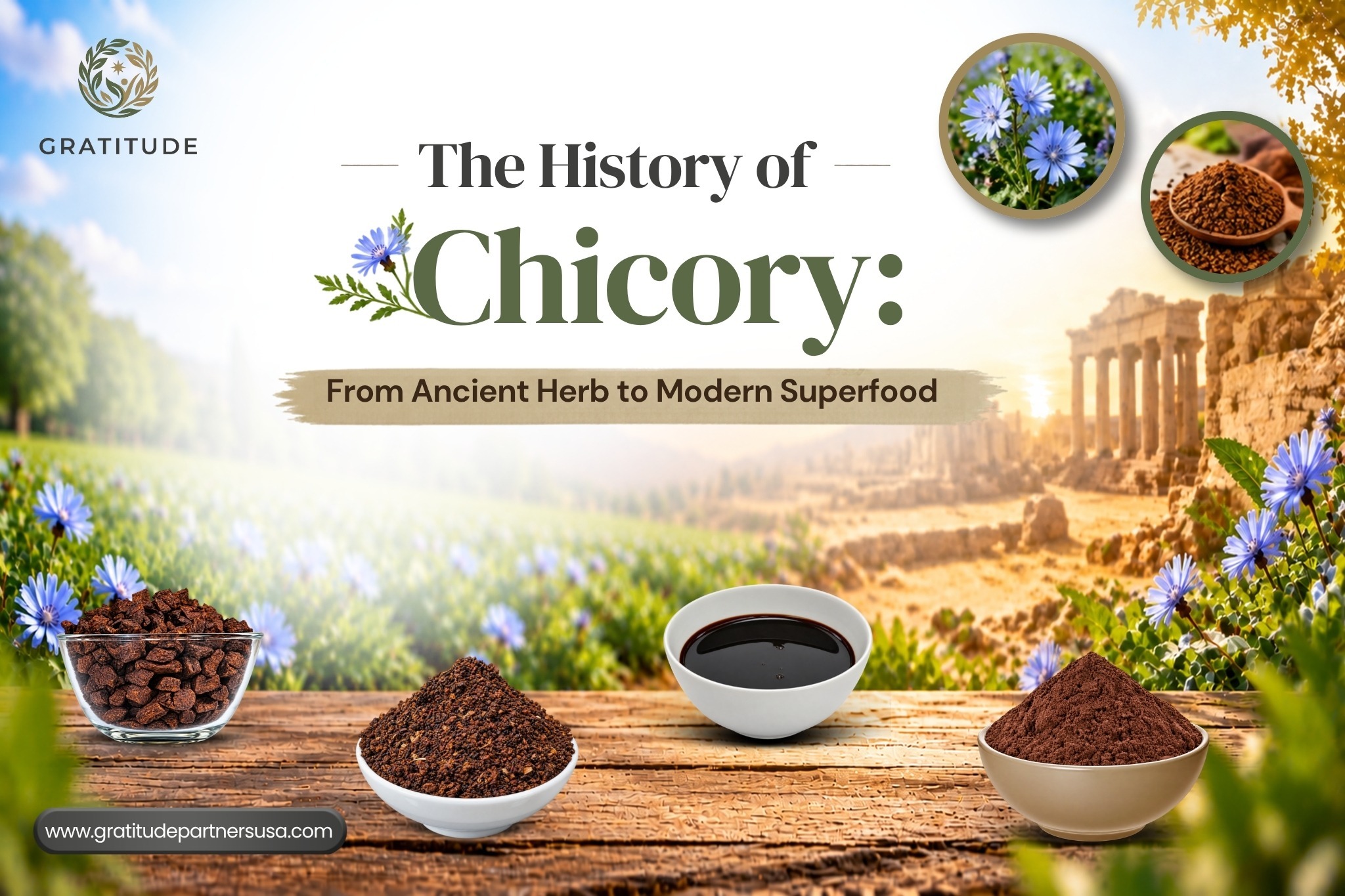
Ask for chicory in your coffee in New Orleans and nobody will blink, because the city has been drinking it that way for generations [1]. The same plant grows wild on European roadsides [1], where most people walk past it without a glance. Yet this plant has been eaten and brewed for a very long time, and it still turns up on ingredient labels today.
This is a short history of how it got from there to here.
A roadside plant with a long record
Common chicory (Cichorium intybus) is a tough, somewhat woody perennial. It is native to Europe, North Africa and western Asia, and in flower it can reach about 1.5 metres. The flowers are usually bright blue, and they appear anywhere from March to October [1]. People have given it plenty of nicknames over the years, among them blue dandelion, blue sailors and wild endive [1].
The name itself comes from Greek. The genus name Cichorium goes back to the Ancient Greek word for endive, and the species name intybus is a Latin variant that also gave English the word "endive" [1].
As for how far back the human story goes, the plant's history reaches to ancient Egypt [1]. That is about as specific as the record gets, so it is wise to be a little wary of any article that claims to know exactly who first ground the root or what they used it for.
On the Roman table
Things get clearer in Rome. A dish called puntarelle was made there with chicory sprouts [1]. The poet Horace mentioned chicory around 30 BC while describing his own plain diet, listing olives, chicory and mallow as what kept him going [1].
Doctors took an interest too. According to the Rome tourism board, writers from Pliny the Elder to the physician Galen described chicory as useful against liver and intestinal complaints [2]. Treat that as what ancient authors believed, not as medical advice. From there the plant moved into medieval monastery gardens and Renaissance vegetable plots [2]. Rome even had a trade built around it, the cicoriaro, who picked wild chicory by hand in the countryside and sold it on the street [2].
Chicory was still a salad and a pot herb at this stage. The cup of coffee came later.
How a salad plant ended up in coffee
Coffee reached Europe, and governments soon noticed how much money was leaving the country to pay for it. In 1766 Frederick the Great banned coffee imports into Prussia [1]. A Brunswick innkeeper named Christian Gottlieb Förster then secured a concession in 1769 to 1770 to make a coffee substitute in Brunswick and Berlin, and by 1795 Brunswick had between 22 and 24 factories of this kind [1].
Germans reached for wheat, barley, dried figs and chicory, among other things [3]. Frederick reportedly hired "coffee smellers" to sniff out roasting beans and fine anyone caught at it [3]. Chicory had one real advantage over the rest. Its root can be roasted and ground much like a coffee bean, and it gives a dark, bitter drink.
France followed. In the Napoleonic era, chicory often showed up either stretching coffee or replacing it outright [1]. Italy did the same, using roasted chicory root as a coffee substitute from the 18th century onward, and leaning on it again during the Napoleonic years and both world wars [2].
New Orleans and the Civil War
Many people believe the chicory habit started in America during the Civil War. The history is a bit older than that. One account points out that Europeans had been adding chicory to coffee for at least a century before the practice reached southern US ports [3].
The war did matter, though. By the 1840s New Orleans was the second-largest coffee importer in the United States, behind New York [1]. When Union naval blockades during the Civil War cut off the port, Louisianans began stretching what coffee they had with chicory root, and the habit stuck [1]. Confederate soldiers also took up chicory as a coffee substitute [1]. Long after the blockade ended, New Orleans kept drinking it, usually with cream and sugar [4].
Hard times, hard drinks
Chicory kept coming back whenever coffee got scarce or expensive. It saw wider use during the Great Depression and again in continental Europe during World War II [1]. In Britain, Camp Coffee, a coffee and chicory essence, has been sold since 1885 and was in use during the Second World War [1]. East Germany introduced a blended "Mischkaffee" of chicory, sugar beet and rye during its coffee crisis of 1976 to 1979 [1].
Some places never stopped liking it. In France, a mix of 60% chicory and 40% coffee is sold under the name Ricoré [1]. Chicory is also stirred into Indian filter coffee, and into coffee in Spanish, Turkish, Syrian, Lebanese and Palestinian cooking [1]. In other words, plenty of people drink it because they like the taste, with no shortage involved.
The leafy side of the family
It would be unfair to leave out the salad branch. Radicchio, Belgian endive and catalogna (puntarelle) all belong to the chicory family [1]. Belgian endive has an unusually specific origin story. The technique for growing blanched endives was discovered by accident in the 1850s at the Botanical Garden of Brussels [1]. The roots are sprouted indoors without light, which keeps the leaves pale and mild. France is now the largest producer of endive [1].
One small trap for shoppers: true endive (Cichorium endivia) is a different species from Belgian endive, even though the two share a genus [1].
Why people talk about chicory root now
Most of today's interest in chicory has to do with inulin, a type of soluble fibre the root stores instead of starch. Fresh chicory root can hold roughly 13 to 23% inulin as a share of its carbohydrate content [1]. Food makers add inulin to products such as yogurt as a prebiotic, and it tastes mildly sweet, at about a tenth of the sweetness of sugar [1].
What does the research say? A systematic review and meta-analysis of 50 randomised controlled trials looked at chicory-derived inulin-type fructans and found a significant rise in Bifidobacteria, a group of gut bacteria, in healthy people and in several groups with health conditions. The one exception was people with gastrointestinal disorders [5]. A summary of the same review reported effects starting at around 3 grams a day, along with more frequent stools in healthy adults and softer stools in healthy infants and children [6].
Two things are worth knowing before you get carried away. First, the review's findings reached the trade press through a chicory fibre supplier, so it is sensible to read the original paper if you plan to make strong claims [6]. Second, these results are about extracted fibre in measured amounts. A cup of roasted chicory coffee is not the same as a studied dose of inulin.
So, is it a superfood?
"Superfood" is a marketing word, not a nutrition term, so it is hard to prove or disprove. Here is what can be said plainly. Raw chicory leaves are about 92% water and supply around 23 calories per 100 grams, along with a lot of vitamin K, vitamin A and vitamin C [1]. The root is a real source of prebiotic fibre. And the plant has fed, healed and caffeinated people for a very long time. That is a better résumé than most trendy ingredients can offer, even if the label "superfood" oversells it.
Chicory in a modern kitchen or factory
If you cook, wild chicory greens are worth trying. Boiling them and draining off the water takes out much of the bitterness, and they are good sautéed with garlic [1].
If you work in food or beverage manufacturing, the plant now comes in many forms. Our guide to types of chicory products explains how roots, cubes, powder, granules and extract differ, and our chicory root guide for beginners covers the basics. To see how the plant is grown and where, read how chicory is grown and where it's found.
Coffee roasters and beverage makers can look at our roasted chicory granules and chicory powder. You can browse the full chicory products range, request a sample, or contact us with your specifications.
The short version
Chicory started as a wayside plant that Egyptians, Greeks and Romans ate. Princes and blockades pushed it into the coffee cup, and a Belgian accident gave it a second life as a pale winter salad. Researchers are now studying the fibre in its root. It has gone in and out of fashion, and it keeps coming back.
Sources
Sources
- 01Wikipedia, "Chicory":en.wikipedia.orghttps://en.wikipedia.org/wiki/Chicory
- 02Turismo Roma, "Cicoria ripassata: sautéed chicory greens, Roman style":turismoroma.ithttps://turismoroma.it/de/node/166663
- 03Barista Magazine, "Coffee Drinks from Around the World: The Origins of Chicory":baristamagazine.comhttps://baristamagazine.com/the-origins-of-chicory/
- 04Royal Coffee, "Chicory":royalcoffee.comhttps://royalcoffee.com/chicory/
- 05NutraIngredients, "Meta-analysis supports prebiotic effect for chicory root fibre" (2022):nutraingredients.comhttps://www.nutraingredients.com/Article/2022/09/05/meta-analysis-supports-prebiotic-effect-for-chicory-root-fibre
- 06Dairy Foods, "Study reveals benefits of chicory root fiber intake":dairyfoods.comhttps://dairyfoods.com/articles/95867-study-reveals-benefits-of-chicory-root-fiber-intake