You have probably seen “chicory root fiber” listed on the back of a granola bar or a box of high-fiber cereal. Maybe you have heard someone mention chicory coffee and thought — is that even real coffee? Or perhaps you are a food buyer trying to figure out if chicory root belongs in your product line.
Whatever brought you here, this guide will walk you through the basics. No jargon, no filler, no assumptions — just a straight answer to the question: what is chicory root, and what can you actually do with it?
What Does Chicory Root Look Like?
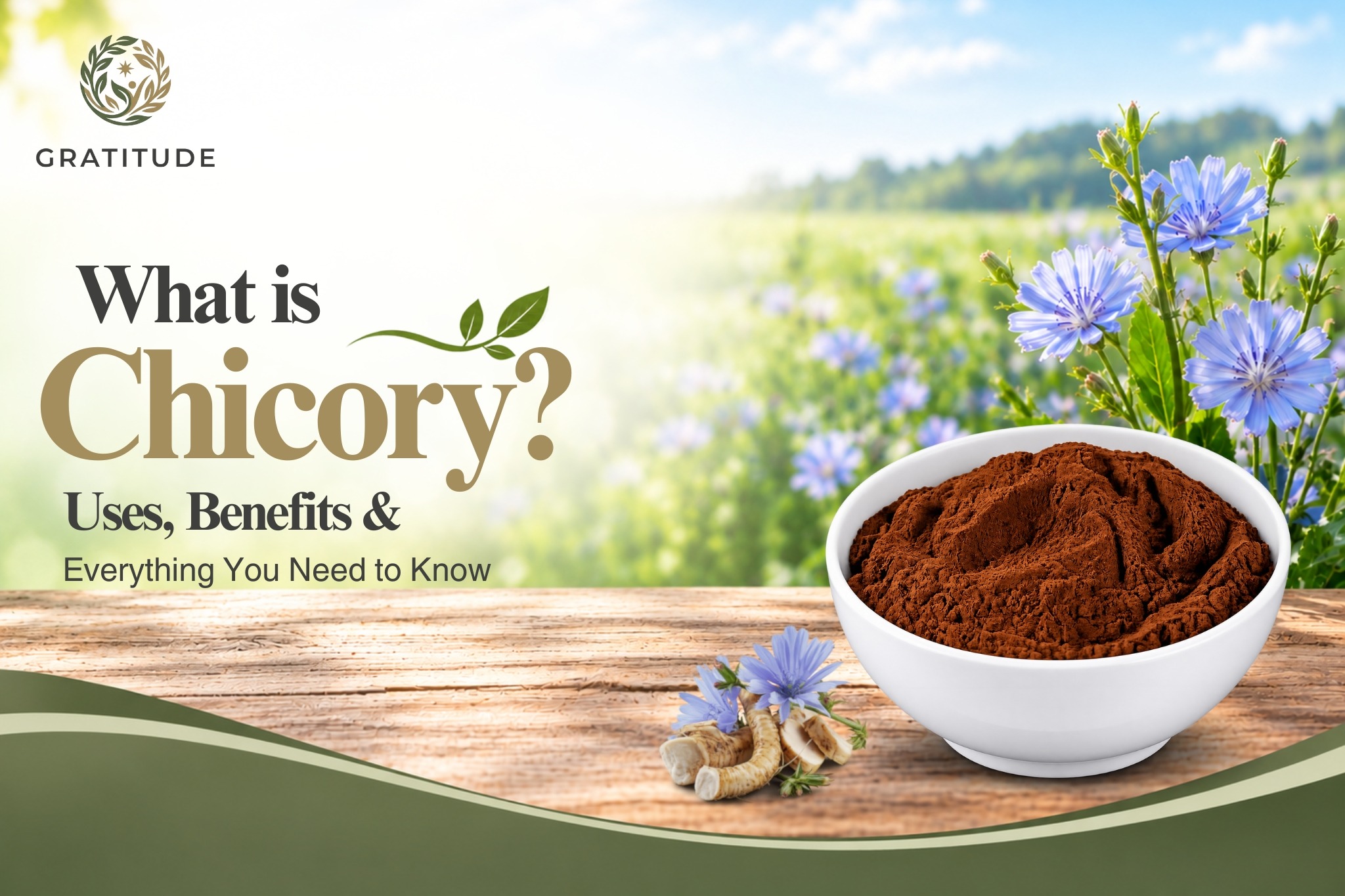
Chicory (Cichorium intybus) is a hardy perennial plant that originally comes from Europe.[1] It has since spread to North America, Australia, and parts of Asia, where it grows wild along roadsides, in fields, and on disturbed land.
Above ground, chicory is easy to spot if you know what to look for. It grows tall (up to about 1.5 metres), has rough stems, and produces small, pale blue flowers that open with the morning sun and close in the afternoon.[1]
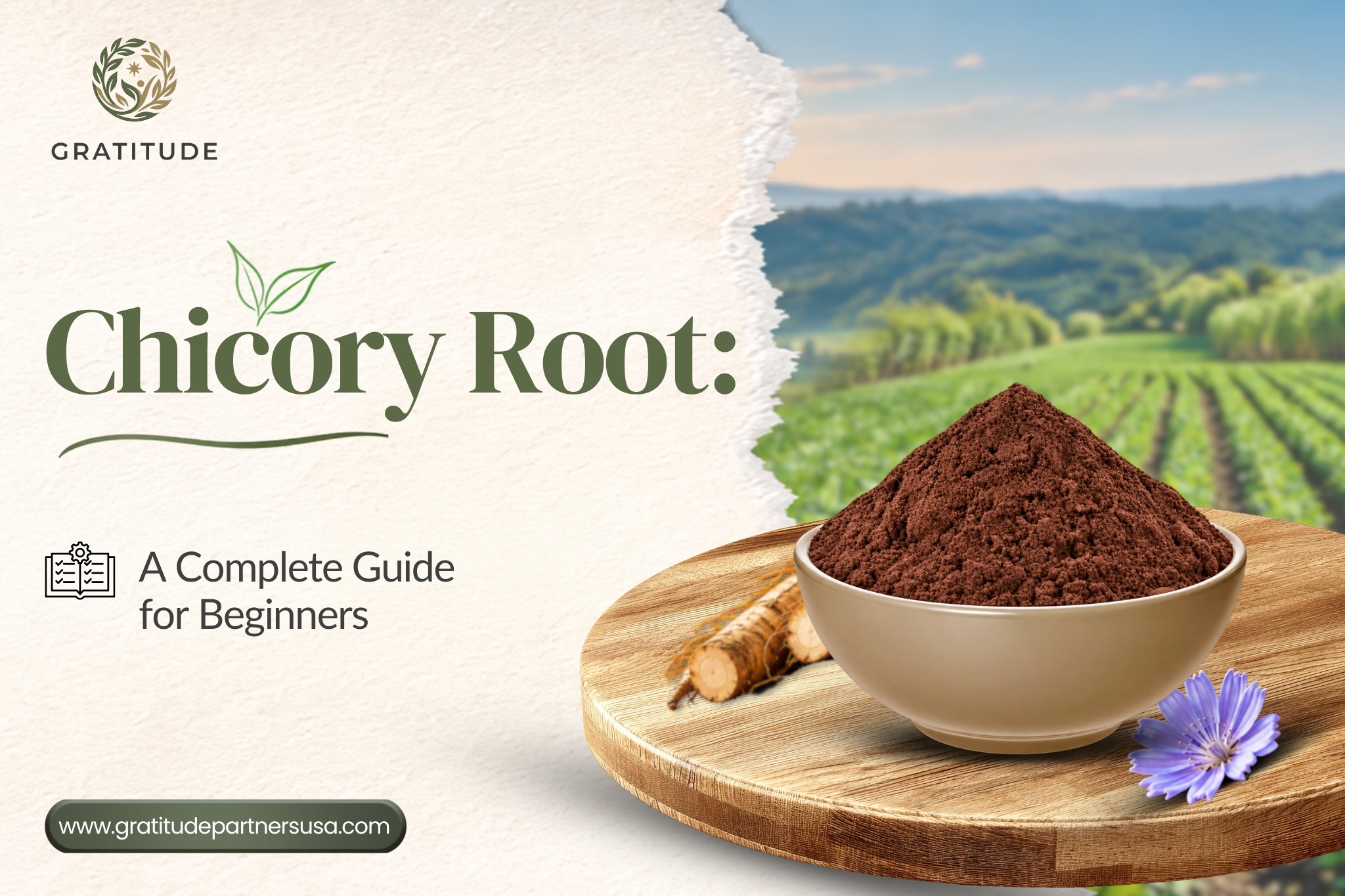
But the part that matters for food and beverages is underground. The chicory plant puts down a long, thick taproot — think of a pale, knobby parsnip — and that root is where all the commercial action happens. It stores a type of soluble fiber called inulin, which we will get to in a moment.
How Chicory Root Goes from Field to Product
If you are new to chicory, understanding how the raw root turns into something you can drink or eat helps make sense of the different chicory products you see on the market. Here is the basic process:[2][3]
Step 1 — Harvesting. Chicory roots are typically dug up in autumn, about 120 to 150 days after planting.[2] The leaves get separated, and only the roots move forward.
Step 2 — Cleaning. The harvested roots are washed thoroughly to remove soil and field debris.
Step 3 — Slicing and drying. The roots are cut into smaller pieces to increase surface area, then dried — either in open air, in industrial drying kilns, or in dehydrators — to pull out the moisture.[3]
Step 4 — Roasting. The dried pieces go into a roaster at around 300°F to 325°F (150°C to 160°C). This is where the magic happens. Roasting develops that dark brown colour and the rich, coffee-like aroma that chicory is known for.[3]
Step 5 — Grinding and packaging. Once cooled, the roasted pieces are ground to the desired consistency — coarse for granules, fine for powder — and packaged for sale.
The result? A finished product that can be brewed like coffee, mixed into food formulations, or processed further into liquid extract.
The Four Main Forms of Chicory Root
Not all chicory products are the same. Depending on how the root is processed, you end up with different forms suited to different uses:
- Roasted Chicory Granules — Coarsely ground roasted root. Used mostly in coffee blending and as a standalone brew. This is the form you will find in New Orleans-style coffee.
- Chicory Powder — Finely ground roasted root. Used in instant coffee mixes, spice blends, and food manufacturing where a smooth texture matters.
- Chicory Cubes — Compressed blocks of dried chicory, typically used as an intermediate product in further processing. These are common in B2B supply chains.
- Chicory Extract — A liquid concentrate made by extracting soluble compounds from the root. Used in beverages, syrups, and food formulations where liquid form is needed.
Each form has its own applications, and which one you need depends on what you are making. If you are not sure, get in touch and we can help you figure that out.
The Inulin Connection (Why Everyone Talks About It)
You cannot read about chicory root without bumping into the word inulin. So here is what it is, explained simply.
Inulin is a type of soluble fiber made up of fructose chains. Your stomach and small intestine cannot break it down, so it passes through undigested until it reaches your large intestine.[4] Once there, the bacteria in your gut feed on it. This is what makes inulin a prebiotic — it is food for your good gut bacteria.
Why does chicory root matter in this context? Because it is one of the richest natural sources of inulin in the world. A fresh chicory root contains roughly 12% to 20% inulin by weight, and dried chicory root can be up to 68% inulin.[5][6]
That is a lot of prebiotic fiber packed into a single root.
For comparison, other foods that contain inulin — like garlic, onions, leeks, and bananas — have far smaller amounts, usually between 1% and 10%.[4] So when food manufacturers want to add prebiotic fiber to a product, chicory root is usually their first choice.
Health Benefits: What the Research Supports
A fair warning before we get into this — chicory root is a food ingredient, not a medicine. It has real, documented benefits, but it is not going to cure diseases. Here is what the science actually says.
Better Bowel Regularity
This is the one benefit with the strongest regulatory backing. In 2015, the European Food Safety Authority (EFSA) authorised a specific health claim: “Chicory inulin contributes to normal bowel function by increasing stool frequency.” The condition is a daily intake of 12 grams of native chicory inulin.[7]
In plain English: eating enough chicory root fiber can help you stay regular. That is not marketing talk — it is a claim backed by clinical trials and approved by a major food safety authority.
Gut Microbiome Support
Clinical studies have shown that chicory inulin promotes the growth of Bifidobacteria, one of the beneficial bacterial groups in your gut.[4][8] A gut with more diverse, healthy bacteria tends to digest food better, absorb more nutrients, and keep your immune system in better shape.
Blood Sugar Moderation
Some research indicates that inulin may slow down sugar absorption in the gut, which could help blunt blood glucose spikes after meals.[9][10] This is still an active area of study, and no regulatory body has approved a specific blood sugar claim for chicory. But the early evidence is worth paying attention to, especially for people watching their carbohydrate intake.
Possible Support for Weight Management
A handful of systematic reviews suggest that inulin intake may modestly help with weight management, likely because it increases the feeling of fullness after eating.[9] These findings are preliminary. Nobody is calling chicory root a weight-loss food, but if you are looking for ways to increase satiety through fiber, it is a reasonable option.
Who Should Be Careful with Chicory Root?
Chicory root is safe for most people when consumed in normal food amounts. But there are a few groups who should tread carefully:
- People with ragweed allergies. Chicory belongs to the Asteraceae plant family, which also includes ragweed, daisies, and marigolds. If you are allergic to ragweed, there is a chance you could react to chicory too.[11][12]
- People with IBS or FODMAP sensitivities. Inulin is a fructan, and fructans are classified as high-FODMAP. For people with irritable bowel syndrome, chicory root fiber can make symptoms like gas, bloating, and cramping worse, not better.[13][11]
- Pregnant or breastfeeding women. There is not enough safety data to confidently recommend high-dose chicory consumption during pregnancy. Some traditional sources suggest it may stimulate uterine activity. The safe move is to avoid medicinal quantities and check with your doctor.[11][12]
- People with gallstones. Chicory may stimulate bile production, which can be a problem if you have gallbladder issues.[11]
If any of these apply to you, talk to a healthcare provider before adding chicory root to your diet.
How Much Chicory Root Fiber Should You Start With?
There is no official “recommended daily intake” for inulin, since it is a type of fiber rather than an essential nutrient. But research and practical experience give us solid guidelines:
- Start small: Begin with 2 to 5 grams per day. This gives your gut bacteria time to adjust.
- Build gradually: Over a few weeks, you can increase toward 10 to 12 grams per day — the range used in most clinical studies and the EFSA-approved health claim.[7]
- Upper limit: Healthy adults have tolerated up to 30 grams per day in short-term studies, but going above 10 grams significantly raises the chance of digestive discomfort.
For context, the USDA recommends a total daily fiber intake of 22 to 28 grams for women and 28 to 34 grams for men from all food sources combined.[14] Chicory root fiber counts toward that total.
The golden rule? Listen to your stomach. If you are bloated or gassy, back off a bit and try again more slowly.
Everyday Ways to Use Chicory Root
You do not need to be a food scientist to get chicory root into your routine. Here are a few practical ideas:
- Blend it into your morning coffee. Mix roasted chicory granules with your regular coffee grounds — a 70/30 or 80/20 coffee-to-chicory ratio is a good starting point. It adds depth and smooths out bitterness.
- Brew it solo as a caffeine-free drink. If you want something warm in the evening but caffeine keeps you up, straight chicory powder brewed in hot water gives you that dark, roasty flavour without any caffeine.[1]
- Check your food labels. If you already eat protein bars, high-fiber cereals, or certain yogurts, there is a good chance you are consuming chicory root fiber (inulin) without realising it.
- Cook with chicory leaves. This is a different product from the root, but worth mentioning. Radicchio and endive are chicory leaf varieties, and they make great salad greens.[1]
Sourcing Chicory Root for Your Business
If you are a food manufacturer, ingredient distributor, coffee company, or beverage maker looking for bulk chicory products, the quality of your supply matters. Root quality depends on the growing region, harvest timing, drying methods, and roasting temperature — and all of that affects the taste, colour, and inulin content of the final product.
At Gratitude Partners USA, we supply roasted chicory granules, chicory powder, chicory cubes, and chicory extract with consistent batch-to-batch quality and full documentation.
Not sure which form is right for your application? Request free samples and test before you commit.
Wrapping Up
Chicory root is one of those ingredients that does a lot of quiet work behind the scenes. It has been in coffee cups since Napoleon’s time, it is in the protein bars at your gym, and it is feeding billions of beneficial gut bacteria in people who have no idea they are eating it.
Now you know what it is, where it comes from, how it is made, what it does for your body, and who should be careful with it. That puts you ahead of most people.
If you still have questions — about chicory root, about sourcing, or about which chicory product makes sense for your needs — drop us a line. We are always up for a conversation about chicory.
References
[1] “Chicory,” Wikipedia, Wikimedia Foundation. https://en.wikipedia.org/wiki/Chicory
[2] “How Chicory Root is Processed,” PMK Chicory. https://pmkchicory.com
[3] “How to Harvest, Dry, and Roast Chicory Root,” Gardener’s Path. https://gardenerspath.com
[4] “Chicory Root Fiber: Health Benefits and Uses,” Medical News Today. https://www.medicalnewstoday.com
[5] “Inulin and oligofructose: review of experimental data on immune modulation,” National Institutes of Health (NIH), PubMed Central. https://pubmed.ncbi.nlm.nih.gov
[6] “Chicory Root and Inulin,” Food and Agriculture Organization (FAO). https://www.fao.org
[7] Commission Regulation (EU) 2015/2314 of 7 December 2015 authorising a health claim on native chicory inulin. Official Journal of the European Union. https://eur-lex.europa.eu
[8] “Inulin and gut microbiota composition — a systematic review,” Oxford University Press (OUP), The Journal of Nutrition. https://academic.oup.com
[9] “Systematic Review and Meta-Analysis of Inulin-Type Fructans on Metabolic Parameters,” MDPI (Multidisciplinary Digital Publishing Institute). https://www.mdpi.com
[10] “Inulin: Uses, Side Effects, Interactions,” WebMD. https://www.webmd.com/vitamins/ai/ingredientmono-1048/inulin
[11] “Chicory — Uses, Side Effects, and More,” WebMD. https://www.webmd.com/vitamins/ai/ingredientmono-92/chicory
[12] “Chicory Root Allergy and Cross-Reactivity,” Rupa Health. https://www.rupahealth.com
[13] “What is Chicory Root Fiber? Nutritionists Explain,” Food Network. https://www.foodnetwork.com
[14] “Dietary Guidelines for Americans 2020–2025,” U.S. Department of Agriculture (USDA). https://www.dietaryguidelines.gov