
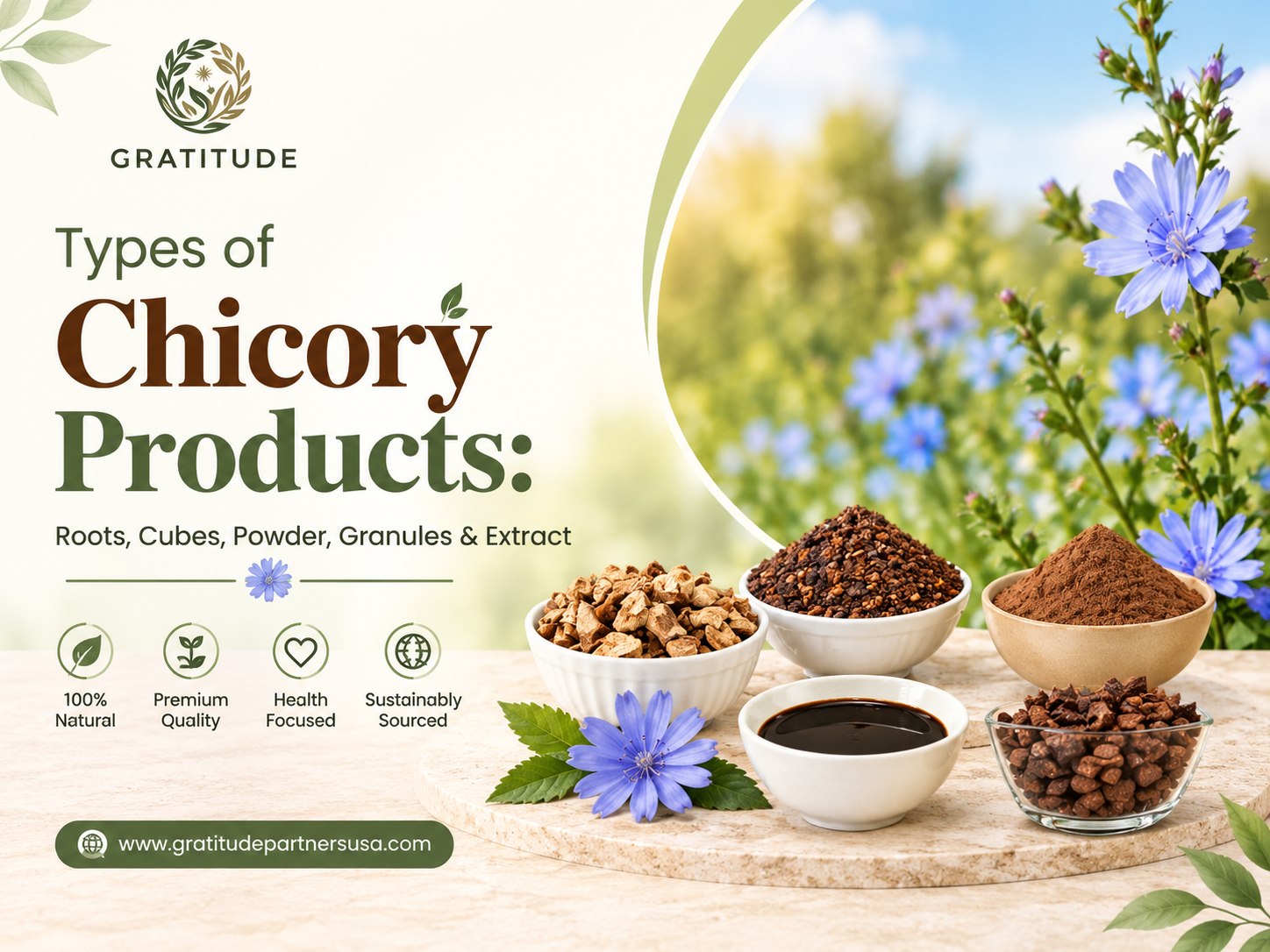
Walk into a food ingredients trade show or browse a supplier catalogue, and you will not find a single product called "chicory." What you will find are chicory roots, chicory cubes, chicory granules, chicory powder, and chicory extract, each one made from the same plant but processed differently and built for different jobs.
If you are a food manufacturer, coffee roaster, beverage maker, or ingredient buyer trying to figure out which chicory product fits your application, this guide breaks down each form, what it is, how it is made, and where it is typically used.
It All Starts with the Same Root
Every chicory product on the market traces back to one place: the taproot of the Cichorium intybus plant. This root is harvested after roughly 120 to 150 days of growth, cleaned to remove soil and debris, and then processed into different forms depending on the end use.[1]
The processing path the root takes after harvest is what creates the product differences. Think of it like wheat: the same grain can become flour, semolina, bulgur, or pasta depending on how you mill and process it. Chicory works the same way.
Here is a walkthrough of each product form, starting from the least processed and moving toward the most processed.
1. Raw Dried Chicory Root
This is chicory in its simplest commercial form. After harvest, the roots are cleaned, sliced, and dried, either in the sun (traditional method) or in industrial drying kilns, until the moisture content drops low enough for safe long-term storage.[2]
What it looks like
Pale to light brown pieces of dried root. No roasting has happened at this stage, so there is no dark colour and no coffee-like aroma.
Who uses it
Dried chicory root is primarily a raw material for further processing. Manufacturers who do their own roasting, grinding, or extraction in-house buy dried root as their starting material. It is also used in herbal tea blends and some traditional medicine applications.[1]
Key spec
Moisture content is typically brought down to around 2% for stability during storage and shipping.
You will not find dried chicory root on a grocery shelf. It lives in the B2B supply chain, shipped in bulk to processors who transform it into one of the products below.
2. Chicory Cubes
Chicory cubes are dried chicory root pieces cut into uniform sizes, usually ranging from 2 mm to 18 mm depending on the buyer's specifications.
How they are made
After cleaning and slicing, the root pieces are dried and sometimes roasted before being sorted by size. The cubes may be sold in their dried (unroasted) state or as roasted cubes, depending on the application.
What makes them useful
Uniformity. By cutting the root into consistent-sized cubes, manufacturers get a product that roasts evenly, extracts predictably, and handles well in automated processing equipment. Think of cubes as the Lego bricks of the chicory supply chain, standardised building blocks that can be turned into whatever the end buyer needs.
Who uses them
Chicory cubes are an intermediate product in the B2B supply chain. Large coffee companies, extract manufacturers, and food processors buy cubes when they want control over the final roasting or grinding step. If you roast and grind in your own facility, cubes are usually what you start with.
Roasted chicory cubes are also blended directly with coffee beans by some manufacturers before grinding, because the cube size can be matched to whole-bean dimensions.
3. Roasted Chicory Granules
Roasted chicory granules are what most people picture when they think of chicory coffee. These are small, dark brown particles, typically 1 to 5 mm in size, produced by roasting dried chicory root and then grinding it to a coarse, granular consistency.[3]
How they are made
The dried root (or dried cubes) goes into a roaster, usually a drum roaster running at temperatures between 100°C and 150°C (about 212°F to 302°F) for up to 90 minutes.[3] This roasting step is where the characteristic dark colour, caramel-like aroma, and coffee-style bitterness develop. After roasting, the root is cooled and ground in a heat-controlled grinder calibrated to produce the granular size.[3]
Why the size matters
The granule size is specifically designed to match the particle size of ground or granulated coffee. When you blend chicory granules with coffee, the two ingredients look visually identical, mix evenly, and brew at the same rate.[3] If the chicory particles were too fine, they would sink to the bottom of a coffee blend. Too coarse, and they would extract differently from the coffee and throw off the taste.
Who uses them
Coffee manufacturers and roasters are the primary buyers, particularly those producing New Orleans-style coffee blends or chicory-blend products. Chicory granules are also sold retail as a standalone brewing product for consumers who want a caffeine-free coffee alternative.[1]
Typical specs:[3]
- Particle size1–5 mm
- Moisturemax 10%
- Extractabilitymin 60%
- Colourdark brown
4. Roasted Chicory Powder
Chicory powder is exactly what it sounds like, roasted chicory root ground to a much finer consistency than granules. The mesh size typically falls between 30 and 60 mesh, which gives it a texture similar to cocoa powder or fine flour.[3]
How it is made: There are two main production routes:
-
Mechanical grinding , Roasted chicory root or cubes are ground very finely using industrial grinders. Straightforward, but the resulting powder may not dissolve as readily in cold liquids.
-
Spray drying , A liquid extract of roasted chicory is atomised and dried into a very fine, highly soluble powder.[3] Spray-dried chicory powder dissolves almost instantly in water, which makes it ideal for instant beverage formulations.
Who uses it: Chicory powder has the widest range of applications of any chicory product form:
- Instant coffee and beverage mixes , The fine particle size and high solubility make it perfect for products that need to dissolve quickly in hot or cold water[3]
- Baked goods , Used as a flavour component and natural colouring agent in breads, cookies, and nutrition bars
- Functional foods , Added to snack bars, cereals, and health drinks for fibre content
- Spice and seasoning blends , Chicory powder adds depth and a mild bitterness to dry rubs and marinades
Typical specs:[3]
- Mesh size: 30–60
- Moisture: max 5–10%
- Extractability: min 74%
- Colour: dark brown to light yellow (depending on roast level)
- Shelf life: 6–18 months
5. Chicory Extract
Chicory extract is the most processed form of chicory root. It is a liquid concentrate produced by extracting the soluble compounds, primarily inulin, sugars, and flavour compounds, from the root using hot water.[4][5]
How it is made: The process works in several stages:
- Cleaned and ground chicory root is soaked in hot water to pull out soluble compounds
- The raw extract is purified to remove proteins, minerals, and free sugars, typically through methods like liming, ion exchange, and membrane filtration[4]
- The purified liquid is concentrated into a thick syrup or dried into a powder (often called "inulin powder" at this stage)
What makes it different: Unlike granules and powder, which retain the whole roasted root in ground form, extract is a purified liquid or syrup. It carries the flavour and soluble fiber content of chicory without any of the solid root material.
Who uses it: Chicory extract has some of the most specialised applications in the food industry:
- Fat replacer , When long-chain inulin from chicory extract is mixed with water, it forms a creamy, gel-like texture that mimics the mouthfeel of fat. Dairy companies use it in reduced-fat yogurts, ice creams, and spreads.[4][5]
- Sugar substitute and bulking agent , Inulin provides mild natural sweetness (roughly 10% to 50% the sweetness of table sugar, depending on chain length) and is used as a sugar-reducing ingredient in baked goods and confectionery.[4]
- Ready-to-drink beverages , Liquid extract mixes directly into drinks without the dissolution step that powders and granules require
- Prebiotic fiber supplements , Chicory-derived inulin is the backbone of many commercial prebiotic fiber products on the market[6]
The global inulin market, dominated by chicory root extraction, was valued at approximately USD 1.9 billion in 2025, with over 60% of demand coming from the food and beverage sector.[7][8]
Quick Comparison: Which Form Does What?
Here is a side-by-side view of all five forms:
| Product | Particle Size | Main Application | Best For |
|---|---|---|---|
| Dried Root | Whole/sliced pieces | Raw material for processors | Buyers who roast and grind in-house |
| Chicory Cubes | 2–18 mm | Intermediate B2B product | Manufacturers wanting roasting control |
| Roasted Granules | 1–5 mm | Coffee blending | Coffee roasters & blenders |
| Roasted Powder | 30–60 mesh (fine) | Instant mixes, baked goods, functional foods | Beverage & food manufacturers |
| Chicory Extract | Liquid/syrup | Fat replacer, sugar reducer, fiber supplements | Dairy, bakery, supplement companies |
How to Pick the Right Chicory Product
Choosing the right form comes down to three questions:
What are you making?
A coffee blend calls for granules. An instant drink mix needs powder. A reduced-fat yogurt needs extract. Match the product form to your end application.
Do you process in-house?
If you have your own roasting and grinding equipment, buying cubes or dried root gives you maximum control over the final product. If you want a ready-to-use ingredient, go with granules, powder, or extract.
What specs do you need?
Roast level (light, medium, dark), particle size, moisture content, extractability, solubility, these all vary between suppliers and between product forms. Always request a technical data sheet and test samples against your production requirements before placing bulk orders.[9]
Sourcing Chicory Products for the US Market
At Gratitude Partners USA, we supply all five forms of chicory to food manufacturers, coffee companies, beverage makers, and ingredient distributors across the United States:
Every batch comes with full documentation and consistent specifications. We work with established growing and processing operations to make sure you get the same quality every time you reorder.
Not sure which product fits your application? Request free samples and test them in your own facility. Or get in touch with us to talk through your requirements, we will point you in the right direction.
Sources
References
- 01ChicoryWikipedia, Wikimedia Foundationen.wikipedia.orghttps://en.wikipedia.org/wiki/Chicory
- 02How to Harvest, Dry, and Roast Chicory RootGardener's Pathgardenerspath.comhttps://gardenerspath.com
- 03Roasted Chicory Granules vs Powder: Manufacturing and SpecificationsStarlonn Naturalsstarlonnaturals.comhttps://starlonnaturals.com
- 04Inulin from Chicory Root: Processing and Food ApplicationsFood and Agriculture Organization (FAO)fao.orghttps://www.fao.org
- 05Chicory Root Fiber: Health Benefits and UsesMedical News Todaymedicalnewstoday.comhttps://www.medicalnewstoday.com
- 06Chicory Root Fiber as a PrebioticHealthlinehealthline.comhttps://www.healthline.com/nutrition/chicory-root-fiber
- 07Inulin Market Size, Share & Trends Analysis ReportFortune Business Insightsfortunebusinessinsights.comhttps://www.fortunebusinessinsights.com
- 08Inulin Market ReportBusiness Research Insightsbusinessresearchinsights.comhttps://www.businessresearchinsights.com
- 09Chicory Products: Roast Profiles and Quality ControlInstant Chicoryinstantchicory.comhttps://instantchicory.com