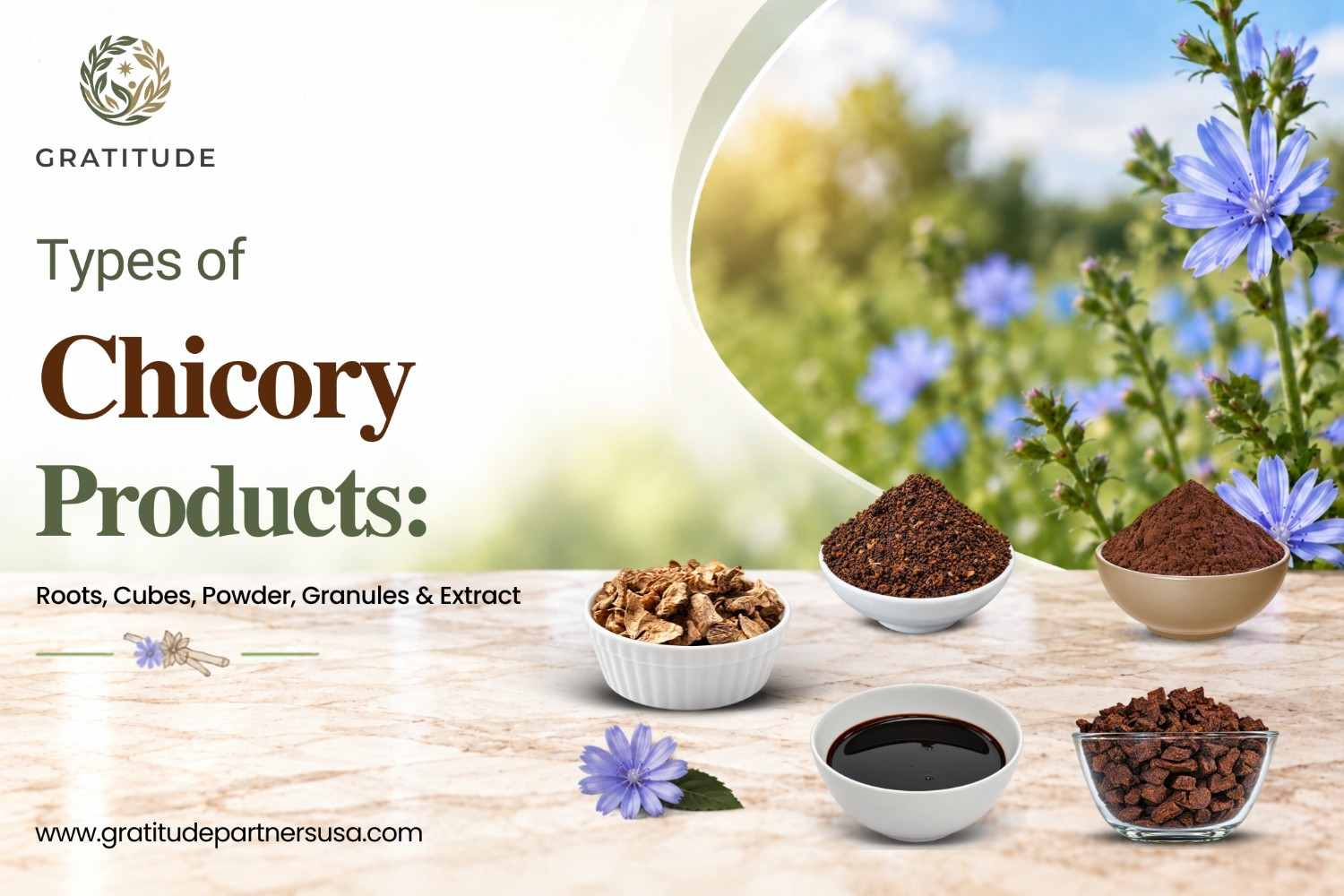

Most people encounter chicory as an ingredient – a word on a coffee label or a line item in a nutrition panel. But chicory starts its life as a plant in a field, and what happens in that field shapes everything that comes after: the taste of the roasted root, the inulin content, and the quality of the finished product.
If you have ever wondered where chicory actually grows, what kind of conditions it needs, or which countries produce the most of it, this guide covers all of that.
What Does the Chicory Plant Look Like?
Chicory (Cichorium intybus) is a perennial plant from the Asteraceae family – the same family that includes sunflowers, daisies, and dandelions.[1] It is a tough, scrappy plant that can grow up to about 1 to 1.5 metres tall, with stiff, grooved stems that branch outward as they grow.
The flowers are the easiest way to recognise it. Chicory produces clusters of small, pale blue flowers (sometimes white or pink, but usually blue) that open in the morning and close by early afternoon.[1] If you have ever noticed blue wildflowers growing along highways or on the edges of parking lots in the United States, there is a decent chance you were looking at chicory.
Below ground is where the money is, though. The plant sends down a thick, fleshy taproot – pale on the inside, brown on the outside, shaped something like a rough parsnip. This root stores large amounts of inulin, a soluble prebiotic fiber, and it is this root that gets harvested and processed into chicory products for the food and beverage industry.
Where Does Chicory Grow Wild?
Chicory is originally native to Europe, where it has been growing wild for thousands of years. Ancient Egyptians, Greeks, and Romans all knew the plant and used it for food and medicine.[1][2]
Over the centuries, chicory has naturalised far beyond its European homeland. Today, you can find wild chicory growing in:
- North America – particularly common along roadsides and in meadows across the United States and southern Canada[1]
- Australia – introduced by European settlers and now widespread in temperate regions
- Parts of Asia – including northern India and China
- Southern Africa – where it grows both wild and as a cultivated crop[3]
Wild chicory tends to pop up in disturbed ground – road shoulders, railway embankments, abandoned lots, field edges. It is not picky about where it grows, which is one reason it has spread so far. The plant handles drought reasonably well thanks to its deep taproot, and it tolerates a wide range of soil conditions.[1]
That said, wild chicory and commercially farmed chicory are quite different in terms of root size and inulin content. Commercial cultivation has been refined over decades to produce much larger roots with higher yields.
What Conditions Does Chicory Need to Grow?
If you want chicory to thrive – especially if you are growing it for its root – the plant has some clear preferences.
Temperature
Chicory is a cool-season crop. It does best in temperatures between 45°F and 75°F (roughly 7°C to 24°C).[4][5] It can handle light frost, which actually helps – a touch of cold in autumn can boost the inulin content in the root.[6] But sustained heat above 80°F tends to push the plant into bolting (shooting up a flower stalk too early), which reduces root quality.
Sunlight
Full sun – at least six hours of direct sunlight per day – works best in cooler climates.[4] In warmer areas, some afternoon shade helps prevent the plant from bolting prematurely.
Soil
This is where things get specific. Chicory is a deep-rooted crop, so it needs loose, well-drained, loamy soil that allows the root to push downward without hitting compacted layers or rocks.[5][7] Heavy clay soil is bad news – it restricts root growth and can cause rot.
The ideal soil pH sits between 5.5 and 7.0.[5][7] Slightly acidic to neutral. The soil also needs consistent moisture but must never be waterlogged. Think damp, not soggy.
Water
Chicory has decent drought tolerance once its taproot is established, but for commercial root production, consistent irrigation matters. Uneven watering can make the root woody or unpleasantly bitter.[4] Most commercial operations use drip irrigation to keep soil moisture steady without wetting the leaves, which reduces the risk of fungal problems.
How Chicory is Grown: The Crop Lifecycle
Growing chicory commercially is not complicated, but it does follow a specific timeline.
Planting. Seeds are sown directly into the field in spring (late March to April in the Northern Hemisphere), once the soil is workable and temperatures are above freezing.[5][7] In milder climates, a fall planting is also possible. Seeds are typically sown in rows, spaced to allow each plant enough room to develop a full-sized root.
Growing period. The crop takes roughly 120 to 150 days from sowing to harvest.[8] During this time, the above-ground plant grows its rosette of leaves and puts energy into building up the taproot below ground. Farmers monitor the crop for weeds (which compete for nutrients), pests, and moisture levels throughout the season.
Harvest. Roots are typically harvested in autumn or early winter, when the leaves begin to dry and yellow – a sign the plant has shifted its energy into the root.[6][8] Harvesting after a light frost is considered ideal, because cold temperatures encourage the root to store more inulin.[6]
The roots are lifted from the ground using specialised machinery (similar to sugar beet harvesters), then cleaned, sliced, dried, and sent to processing facilities where they are turned into roasted chicory granules, chicory powder, chicory cubes, or chicory extract.
Crop rotation. Chicory should not be planted in the same field year after year. A three-year rotation is recommended to prevent soil-borne diseases, nematodes, and fungal buildup.[9] It is often rotated with grasses, corn, or small grains, and it fits well into rotation schedules alongside sugar beets since both crops share similar equipment and soil needs.[9]
Where is Chicory Grown Commercially?
Wild chicory grows all over the world, but large-scale commercial production is concentrated in a handful of regions. Here is where most of the world’s chicory comes from.
Europe
Europe is the historical heartland of commercial chicory production and still holds the largest share of global output.[10][11]
- Belgium – One of the oldest and most established chicory-producing nations. Belgium is particularly famous for witloof (Belgian endive), a leaf chicory variety, but it has a strong root chicory sector too.[2][11]
- France – A leading producer, especially in the northern regions around Nord-Pas-de-Calais, where chicory has been cultivated for over two centuries. France is the birthplace of chicory coffee culture, dating back to Napoleon’s Continental Blockade.[2][10]
- The Netherlands – A significant player with well-developed processing infrastructure, particularly for extracting inulin from chicory roots.[10][11]
Other European producers include Poland and Germany, though on a smaller scale.
India
India has emerged as a major global chicory producer over the past several decades. Cultivation started in the late 1950s and initially struggled in southern India, but once farming shifted to the northwestern states, the crop took off.[12]
Today, chicory in India is grown primarily in Gujarat and Uttar Pradesh, which together account for the vast majority of the country’s production.[12][13] India is now a leading exporter of chicory powder to international markets, including the United States and Europe.
South Africa
South Africa has a notable chicory farming industry, concentrated in the Eastern Cape and Western Cape provinces. The country has been growing chicory commercially for over a century, with production methods refined to suit local soil and climate conditions.[3]
United States
The United States does not grow chicory on the same scale as Belgium or India, but the plant grows wild across much of the country and has been part of American food culture since the Civil War, when it became a coffee substitute in New Orleans.[1] Most of the chicory used in American food manufacturing today is imported.
Root Chicory vs. Leaf Chicory: Two Different Crops
One thing worth clearing up – “chicory” can refer to two quite different products depending on which part of the plant you are growing it for.
Root chicory is grown for the taproot. The root is harvested, dried, roasted, and ground into products used in coffee blending, food manufacturing, and inulin extraction. This is the type that food manufacturers, coffee companies, and ingredient distributors deal with.
Leaf chicory is grown for the leaves. This includes varieties you might recognise from the produce aisle: radicchio (red chicory), Belgian endive (witloof), puntarelle, and catalogna.[1][2] These are salad vegetables, bitter in taste, and have nothing to do with the coffee and fiber side of the chicory industry.
Same plant species. Completely different end products.
Why Growing Region Matters for Product Quality
If you are buying bulk chicory products for food manufacturing or beverage production, the origin of the chicory root is worth paying attention to.
Growing conditions directly affect:
- Inulin content – Cooler climates and a good frost before harvest tend to produce roots with higher inulin levels[6]
- Flavour profile – Soil type, roasting method, and root maturity all influence whether the final product tastes more caramel-like, nutty, or woody
- Root size and yield – Well-managed commercial farms on good loamy soil can produce average yields of around 60 tons per hectare[14]
- Consistency – Industrial buyers need batch-to-batch consistency, which depends on the supplier’s control over sourcing, processing, and quality testing
At Gratitude Partners USA, we source chicory from established growing regions and supply roasted chicory granules, chicory powder, chicory cubes, and chicory extract with full documentation and consistent specifications to food manufacturers, coffee companies, and ingredient distributors across the United States.
Want to check the quality for yourself? Request free samples before placing an order.
Final Thoughts
Chicory is a remarkably adaptable plant. It grows wild on four continents, thrives in cool weather on well-drained soil, and has been farmed commercially in Europe for over two hundred years. The same root that Napoleon-era French citizens roasted as a coffee replacement is now a billion-dollar global crop, powering everything from New Orleans coffee blends to prebiotic fiber bars.
Understanding where chicory comes from and how it is grown gives you a better picture of the ingredient itself – and if you are sourcing it for your products, it helps you ask the right questions about quality, origin, and consistency.
Got questions about chicory sourcing or products? Reach out to us – we are always happy to talk shop.
References
[1] “Chicory,” Wikipedia, Wikimedia Foundation. https://en.wikipedia.org/wiki/Chicory
[2] “Chicory,” Encyclopaedia Britannica. https://www.britannica.com/plant/chicory
[3] “Chicory Production Guideline,” Department of Agriculture, Forestry and Fisheries, Republic of South Africa. https://www.nda.gov.za
[4] “How to Grow Chicory,” GrowVeg. https://www.growveg.com
[5] “Chicory Growing Guide,” Smart Gardener. https://www.smartgardener.com
[6] “Chicory Crop Guide: Nutrition and Fertilisation,” Yara UK. https://www.yara.co.uk
[7] “Chicory,” Natural Resources Conservation Service, U.S. Department of Agriculture (USDA). https://www.usda.gov
[8] “Chicory Cultivation: A Complete Guide,” Krishi Jagran. https://www.krishijagran.com
[9] “Chicory Root Cultivation and Crop Rotation Practices,” Deep Green Permaculture. https://deepgreenpermaculture.com
[10] “Chicory Market Size & Share Analysis,” Mordor Intelligence. https://www.mordorintelligence.com
[11] “Chicory Market Analysis,” Fact.MR. https://www.factmr.com
[12] “Chicory Cultivation in India,” Krishi Jagran. https://www.krishijagran.com
[13] “Chicory Root: Nutrition Facts and Health Benefits,” Healthline. https://www.healthline.com/nutrition/chicory-root-fiber
[14] “Chicory Root Yield and Harvesting Practices,” Agricom New Zealand. https://www.agricom.co.nz